PARS DEFENCE

Drone guide

A practical reference for buyers, operators and engineering teams. From platform types and components to batteries, regulations and terminology.

Platform types

Each airframe trades endurance, payload and ease of operation differently. The right choice follows from the mission.

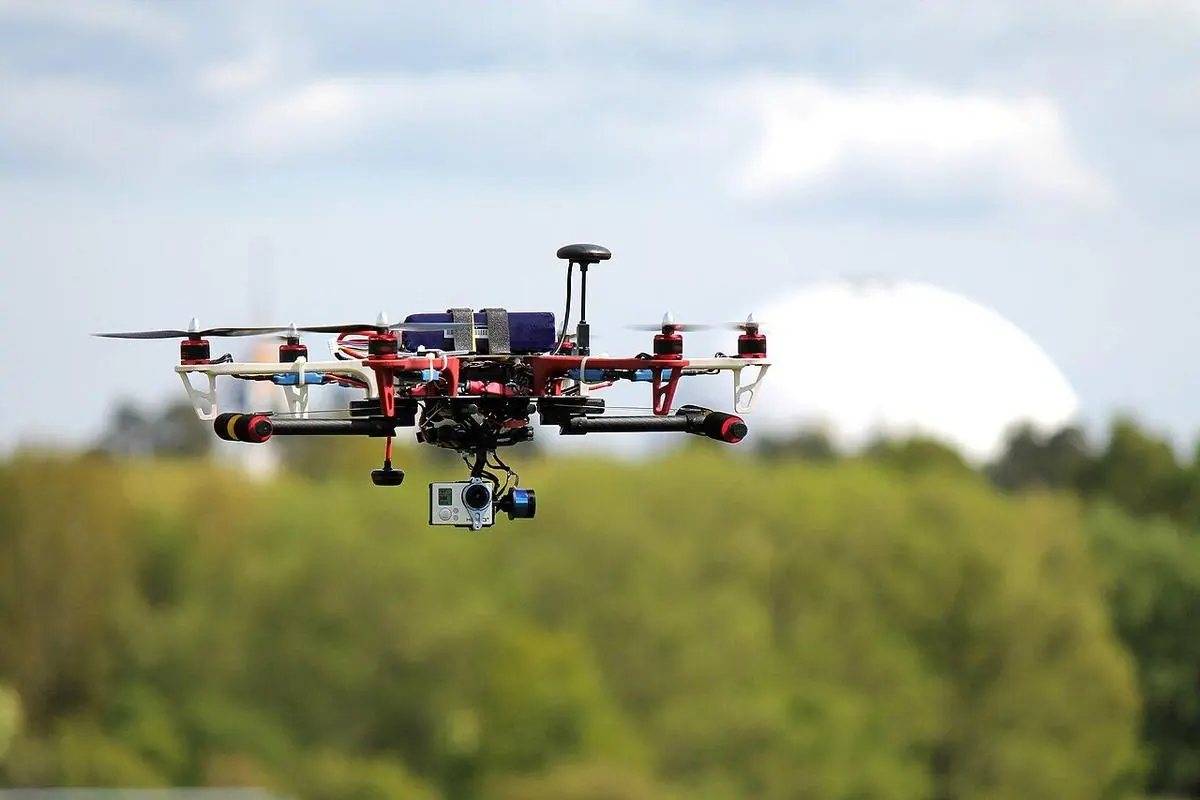
Hexacopter with camera in flight

Multirotor

Four, six or eight rotors provide lift and control through differential speed. Multirotors take off vertically, hover precisely and are the simplest platform to operate, at the cost of endurance.

Typical endurance
15 to 45 min
Strengths
Hover, precision, compact launch
Typical use
Inspection, photography, mapping, delivery trials

Fixed-wing

A wing generates lift, so the motor only overcomes drag. Fixed-wing aircraft cover large areas efficiently but need space or a launcher to take off and land, and cannot hover.

Typical endurance
1 to several hours
Strengths
Range, area coverage, efficiency
Typical use
Large-area mapping, corridor surveys, patrol and monitoring

Hybrid VTOL

Combines lift rotors for vertical take-off with a wing and forward motor for cruise. It removes the runway requirement of fixed-wing aircraft while keeping most of their range.

Typical endurance
1 to 3 hours
Strengths
Runway-free, long range
Typical use
Surveying, pipeline and power-line patrol

Single-rotor helicopter

One main rotor with a tail rotor or a coaxial layout. Larger rotor disc gives good efficiency and heavy payload capacity, with more mechanical complexity and maintenance.

Typical endurance
1 to 4 hours (fuel powered)
Strengths
Payload, endurance with hover
Typical use
Heavy lift, LiDAR, long-duration hover
FPV racing gates lit in neon

FPV

Flown manually through live video goggles, usually in acro (rate) mode without self-levelling. FPV airframes are light, fast and agile, used for racing, cinematography and close-proximity inspection.

Typical endurance
3 to 10 min (5 in), longer for long-range builds
Strengths
Agility, speed, low cost of parts
Typical use
Racing, cinematic shots, indoor inspection

Components of a multirotor

Select a component to see what it does and what to consider when choosing it.

  1. Convert motor torque into thrust. Diameter and pitch set the thrust and efficiency; larger, slower propellers are more efficient, smaller ones respond faster.

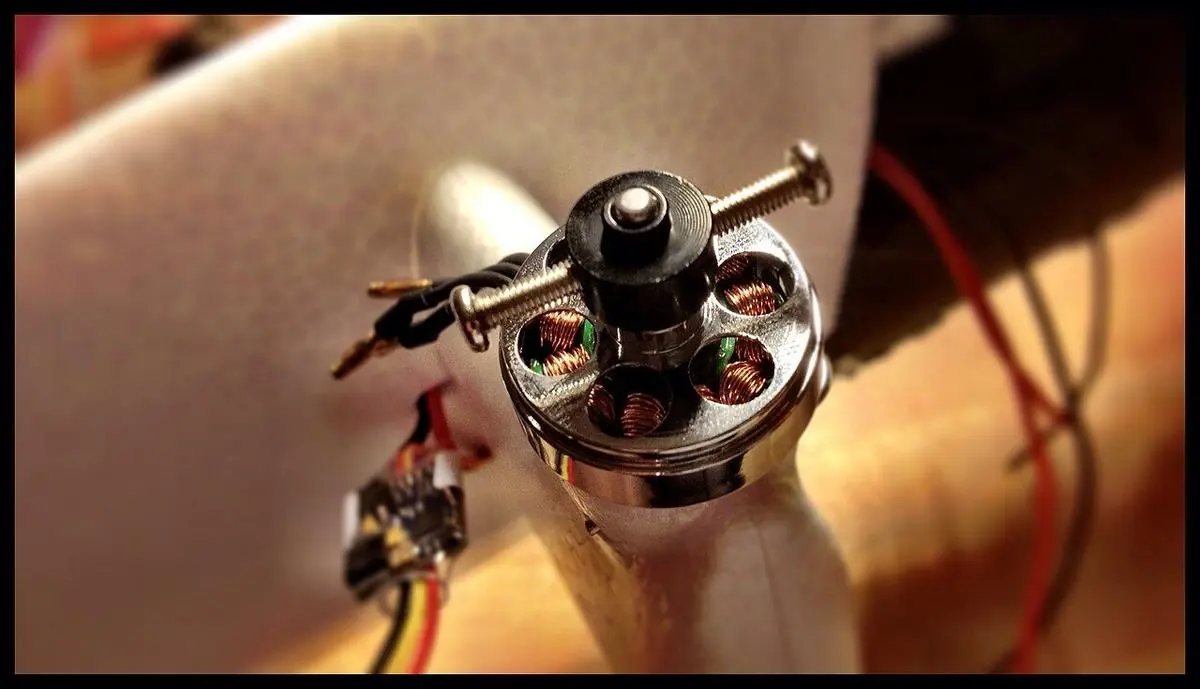
  2. Outrunner motors sized by stator dimensions (e.g. 2207 = 22 mm wide, 7 mm tall). KV defines RPM per volt and must match the propeller and battery voltage.

  3. Carbon-fibre structure carrying all components. Arm stiffness affects vibration and flight controller tuning.

  4. Electronic speed controllers drive each motor from flight controller commands. Rated by continuous current; protocols include DShot and PWM.

  5. Processor with IMU sensors running firmware such as Betaflight, INAV, ArduPilot or PX4. Stabilises the aircraft and runs navigation.

  6. Lithium polymer or lithium-ion pack. Voltage (cell count) sets power, capacity sets endurance, and discharge rating limits current.

  7. FPV camera for piloting, or a stabilised gimbal camera, thermal sensor or LiDAR for the mission itself.

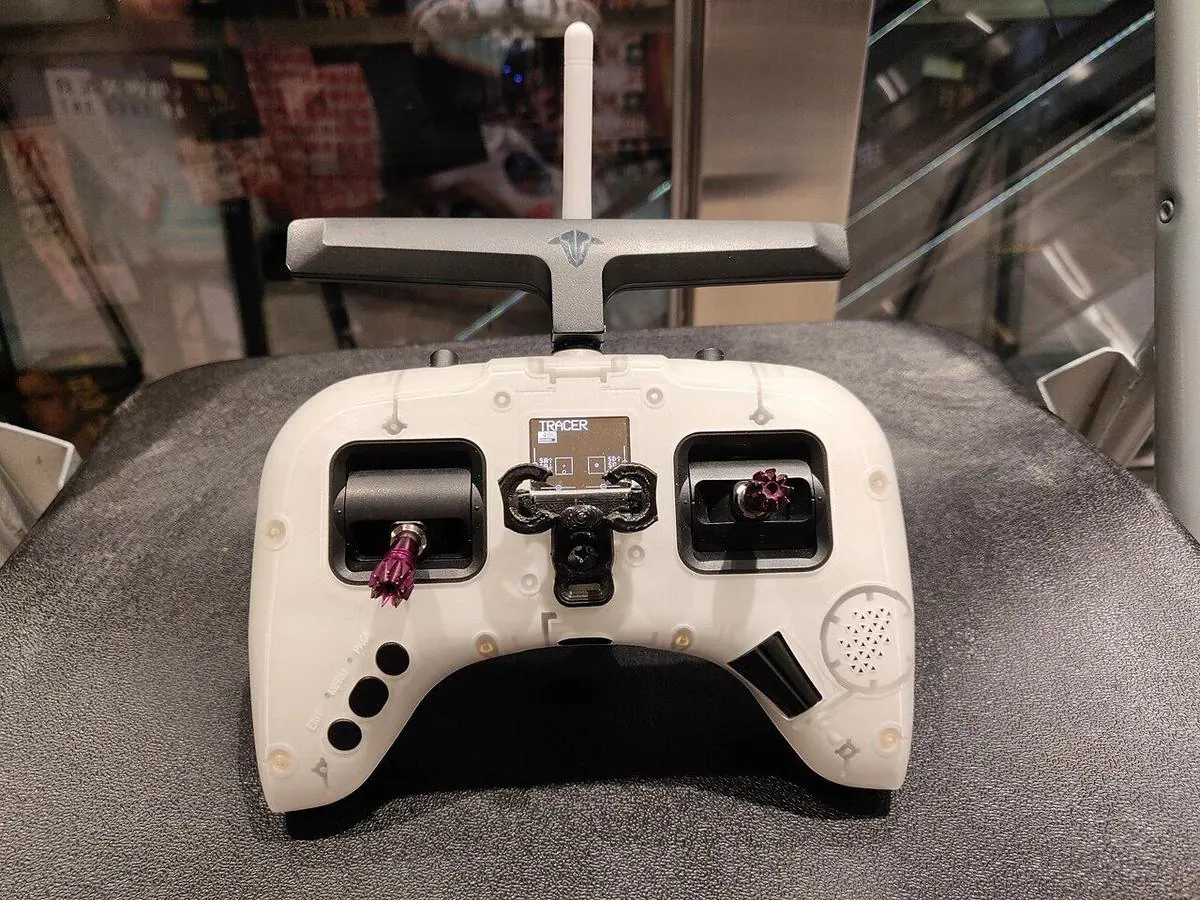
  8. Receives control commands and, in most systems, returns telemetry. Antenna placement directly affects range and link reliability.

  9. Satellite positioning (GPS, GLONASS, Galileo, BeiDou) with compass, enabling position hold, return-to-home and autonomous missions.

How a multirotor flies

A multirotor has no control surfaces. Every manoeuvre comes from changing the speed of individual motors.

Lift

All motors produce thrust upward. When total thrust equals weight, the aircraft hovers; more thrust climbs, less descends.

Pitch and roll

Speeding up the motors on one side and slowing the opposite side tilts the aircraft, directing part of the thrust horizontally.

Yaw

Adjacent motors spin in opposite directions. Speeding up one rotation pair creates a net torque that turns the aircraft around its vertical axis.

Stabilisation

The flight controller reads gyroscopes and accelerometers hundreds to thousands of times per second and corrects motor speeds through PID control loops.

Lithium battery safety

Lithium packs store a large amount of energy in a small volume. Correct handling prevents most incidents.

Battery calculator
  • Balance-charge at 1C or less unless the manufacturer specifies otherwise, on a non-flammable surface and never unattended. Do not charge below 0 °C or while packs are still hot.
  • Select the correct charge mode: LiPo 4.20 V, LiHV 4.35 V per cell. Charging a LiPo in LiHV mode overcharges it and can cause a fire.
  • Parallel-charge only packs with the same cell count and within 0.1 V per cell of each other.
  • Store LiPo and LiHV packs at 3.80-3.85 V per cell and Li-ion at 3.6-3.7 V per cell if they will not be used for more than two days.
  • LiPo: land at about 3.5 V per cell under load (about 3.7 V at rest) and never go below 3.0 V. Li-ion: land at about 3.0 V per cell under load and never go below the cell's rated minimum (2.5-2.8 V).
  • Retire swollen, punctured or damaged packs. Before recycling, discharge them with the charger's discharge function, tape the terminals and take them to a battery collection point.
  • Air travel: spare batteries in cabin baggage only, with terminals protected. Up to 100 Wh without approval; 100-160 Wh with airline approval (usually two spares at most); above 160 Wh not permitted on passenger aircraft. Air cargo ships as UN3480 or UN3481 at 30 % state of charge or less.
  • Transport and store packs in fire-resistant bags or cases.

Regulations in Türkiye

Under SHGM's Unmanned Aircraft Systems Instruction (SHT-İHA), in force since 30 July 2026, flight privileges depend on the pilot licence (P0, P1, P2) and the operating area. Registration depends on the aircraft's weight and on-board sensors such as cameras or microphones.

Pilot licences (in force from 30 July 2026)

LicenceScopeMinimum age
P0Recreational flights within visual line of sight10
P1Commercial flights within visual line of sight18
P2Beyond visual line of sight and high-risk operations (class 3 medical certificate required)18
  • Registration and flight notifications are handled through SHGM's İHATTYS system. Confirm whether your aircraft must be registered before flying.
  • Holders of certificates issued under the previous system have a transition period until 31 July 2027.
  • The instruction introduces remote identification and geofencing requirements.
  • Flights near airports, military zones and other restricted areas require separate permission.
  • Radio control and video links must use the frequencies and power levels permitted by BTK. For example, 915 MHz long-range links are not permitted in Türkiye; use the 868 MHz band.

This summary is for general information and is not legal advice. Last checked: 4 October 2026. Rules change; confirm current requirements with SHGM (web.shgm.gov.tr) before operating.

Glossary

AUW
All-up weight. The total take-off weight including battery and payload.
BVLOS
Beyond visual line of sight. Operations where the pilot cannot see the aircraft directly.
C rating
Battery discharge rate relative to capacity. A 1.3 Ah pack rated 100C can in theory deliver 130 A.
DShot
Digital protocol between flight controller and ESC, more precise and robust than analogue PWM.
ESC
Electronic speed controller. Converts DC battery power into three-phase drive for a brushless motor.
Failsafe
Pre-set behaviour when the control link or another critical system fails.
Geofencing
Software boundary that prevents the aircraft from entering restricted airspace.
GNSS
Global navigation satellite systems: GPS, GLONASS, Galileo and BeiDou.
GSD
Ground sampling distance. The ground size represented by one image pixel.
IMU
Inertial measurement unit. Gyroscope and accelerometer that measure rotation and acceleration.
KV
Motor speed constant in RPM per volt, unloaded. A 1950 KV motor on 22.2 V turns about 43,000 RPM without a propeller.
LiHV
High-voltage lithium polymer cells charged to 4.35 V instead of 4.2 V.
MTOW
Maximum take-off weight. The heaviest weight at which the aircraft is permitted to take off.
Payload
Equipment carried for the mission, such as a camera, sensor or delivery package.
PID
Proportional, integral, derivative. The control loop that keeps the aircraft stable.
Pitch
The distance a propeller would advance in one revolution, in inches. Higher pitch means more speed and current.
Remote ID
Broadcast identification of an aircraft in flight, readable by authorities.
RTH
Return to home. Automatic flight back to the take-off point, usually on signal loss or low battery.
RTK
Real-time kinematic positioning. Corrects GNSS to centimetre-level accuracy using a base station.
Stator size
Motor stator width and height in millimetres, written as four digits, e.g. 2207.
Telemetry
Flight data sent from the aircraft to the ground: battery voltage, position, altitude, link quality.
Thrust-to-weight
Total available thrust divided by all-up weight. At least 2:1 for a controllable multirotor.
VLOS
Visual line of sight. The pilot maintains direct unaided visual contact with the aircraft.
VTX
Video transmitter that sends the FPV camera image to the pilot's goggles or monitor.